Last updated: August 2026 — 9 masterworks researched and verified against museum records, new sources added throughout. Reviewed by the ChinaArtlover editorial team.
Quick answer: The most celebrated Chinese horse paintings span thirteen centuries — from the Six Horses of Zhaoling carved for Emperor Taizong’s tomb (636 AD) and Han Gan’s Night-Shining White (Tang dynasty), through Song and Yuan masterworks by Li Gonglin, Gong Kai, Zhao Mengfu and Ren Renfa, to Giuseppe Castiglione’s imperial scroll One Hundred Horses (1728) and Xu Beihong’s iconic ink-wash galloping horses from the 1940s. Together they trace how the horse became one of the most enduring symbols of energy, loyalty and national spirit in Chinese art.
The Art of Chinese Horse painting
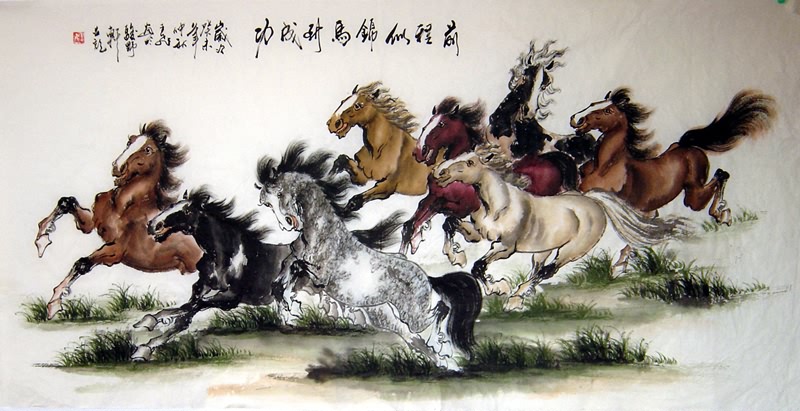
Without restraint, the horse is a universal symbol of freedom. Horses are ranked highly in traditional Chinese thought, holding equally high status in classical Chinese painting as a symbol of energy, ambition and aspiration. It’s one of the most loved animals in Chinese art history, and generations of painters have made the horse a lifelong subject — no surprise that Chinese horse painting is one of the most popular themes in Chinese ink painting (Guo Hua)
The Horse in Chinese zodiac signs
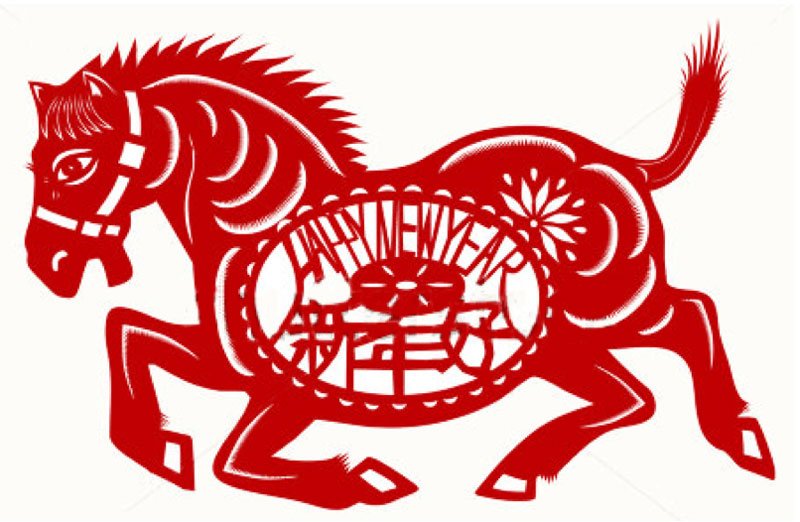
In the Chinese zodiac, the horse (馬) ranks seventh among the twelve animal signs. There’s a long tradition around the Horse in Chinese mythology, and certain traits are traditionally associated with people born in a Horse year — independence, quick wit, optimism and restlessness among them. In ancient times the horse was also linked to noon, since horses were said to run and neigh most freely at midday.
Chinese Horse Painting History
Horse painting rose to particular prominence under the Tang dynasty. Emperor Taizong (r. 626–649) was passionate about horses in war and diplomacy alike, and that passion carried directly into art: his tomb complex, Zhaoling, was decorated with stone reliefs of his six favorite war horses — arguably the founding monument of Chinese horse art, and the direct ancestor of everything on this list.
9 Famous Chinese Horse Paintings You Should Know
These nine works span the Tang dynasty through the 20th century — imperial commissions, scholar-painter allegories, and modern ink masterpieces. Each entry includes the artist, approximate date, and where the work (or the closest surviving version) can be found today.
1. Six Horses of Zhaoling (昭陵六骏)
We’re starting with a stone relief, not a painting — but it earns its place here because it’s the origin point everything else on this list descends from. The Six Horses of Zhaoling are six monumental stone relief carvings made for Emperor Taizong’s mausoleum in 636 AD, the earliest and most politically significant horse artwork in Chinese history. Commissioned to honor the six war horses Taizong rode during the campaigns that founded the Tang dynasty, the reliefs were first designed as paintings by court painter Yan Liben and only then carved into stone by Yan Lide — making Yan Liben’s lost original portraits the direct ancestor of the horse-painting tradition that Han Gan, and everyone after him, inherited. Each panel is roughly 2.5 meters high.
Two of the six — “Saluzi” and “Quanmaojun” — were removed from China in 1914 and are now held by the Penn Museum in Philadelphia; the remaining four are at the Beilin Museum in Xi’an.
2. Ink-wash galloping horse
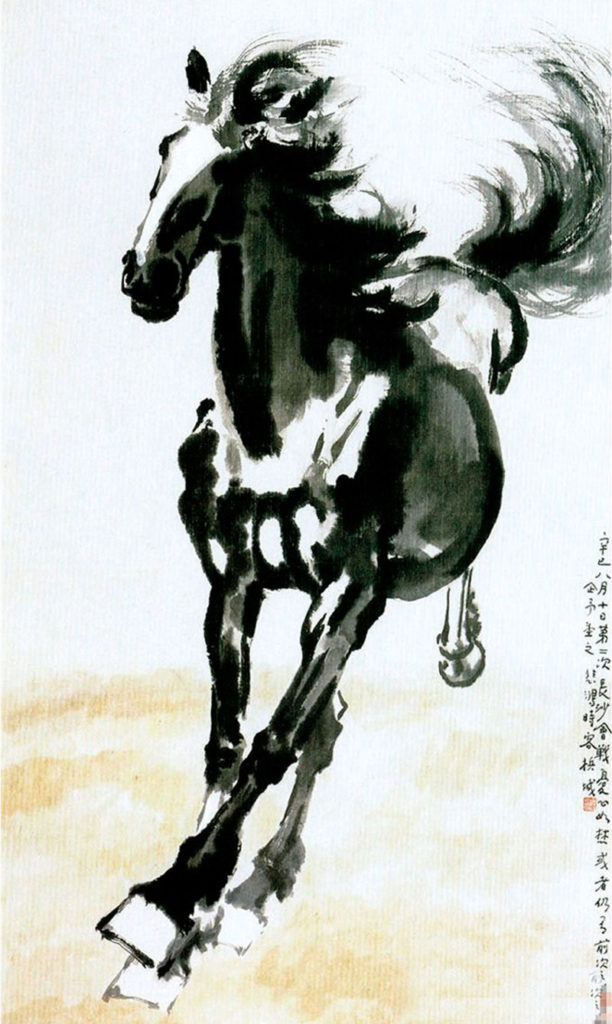
While talking about the famous Chinese horse painting the first name that came into the mind of most art lovers would be “ink-wash galloping horse”. It was painted in 1941 with a 326cm x 112cm dimension.
It was painted by Xu Beihong who is considered to be the pioneer of modern Chinese painting particularly horse painting at the beginning of the 20th century.
Xu Beihong’s painted the most famous Chinese horse painting “ink-wash galloping horse” a traditional Chinese ink-wash brushstroke along with a typical western perspective. Such a masterpiece with this combination was never seen before in traditional Chinese painting.
He was born in an ordinary family but his talent wasn’t ordinary for sure. It was because of his efforts and art that the horse becomes the symbol of national spirit and unity he has painted multiple masterpieces through his career. He transformed Chinese painting with his vivid portraits of horses.
3. Night-Shining White

This portrait of Night-Shining White, a favorite steed of Emperor Xuanzong, is probably one of the most famous horse paintings in Chinese art. The animal with its fiery temperament is the epitome of Chinese legends about imported “heavenly steeds” that “sweated blood” and were in fact dragons in disguise.
The painting is a masterpiece of the famous Chinese painter Han Gan. It is a monochrome ink on a paper painting created in mid of the 8th century with 30.8cm x 34cm dimensions.
With a fiery-tempered, burning eye, dancing hoof, and flaring nostrils Han Gan painted this famous Chinese painting to not only capture the outer appearance of the subject but inner essence as well.
Han Gan came from a poor background during the Tang dynasty. Later he was recognized by the famous poet of that era Wang Wei who sponsored him learning the arts of painting.
4. One hundred horses

“One hundred horses” another famous Chinese horse painting was drawn by Lang Shining whose real name was Giuseppe Castiglione in 1728. He was an Italian painter who served the Qing dynasty as a court painter for more than 50 years. His painting abilities were highly rated among Chinese emperors. He was highly skillful at painting horses. This “one hundred horses” painting was 813 cm long(!) and 102 cm wide having a hundred horses in different postures kneeling, running, standing and eating.


Following the taste and tradition of painting in China, Castiglione was able to forge a new style that combined elements with his Western training in art. His paintings were done with Chinese materials but often incorporate Western techniques of shading and atmospheric perspective. In addition to the shadows, Castiglione has adapted the traditional texture stroke methods of Chinese painting to give the objects even more substance. The emphasis on washes of color, however, still reveals the focus on native techniques.
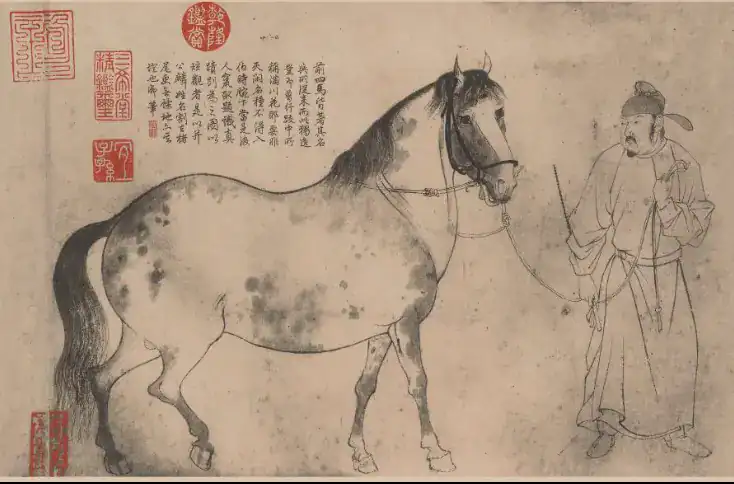
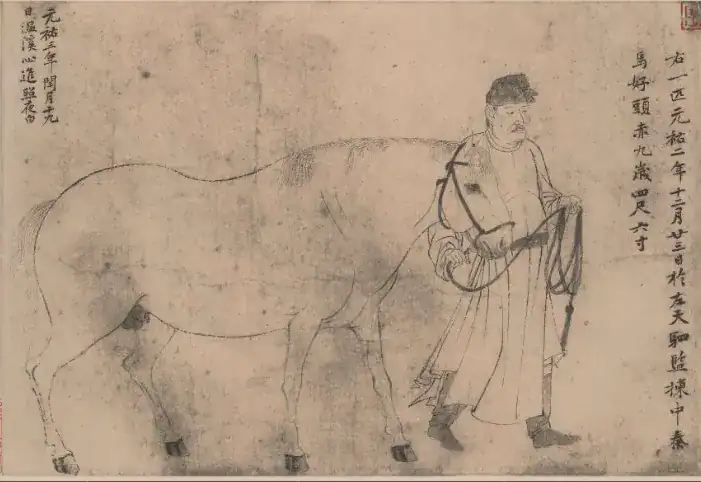
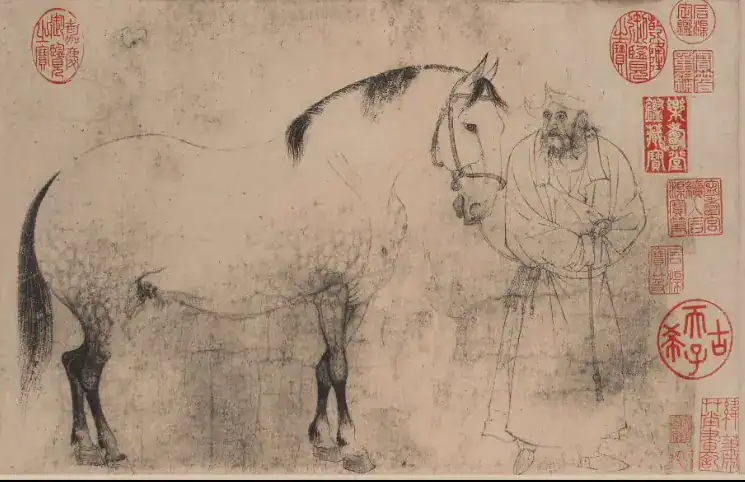
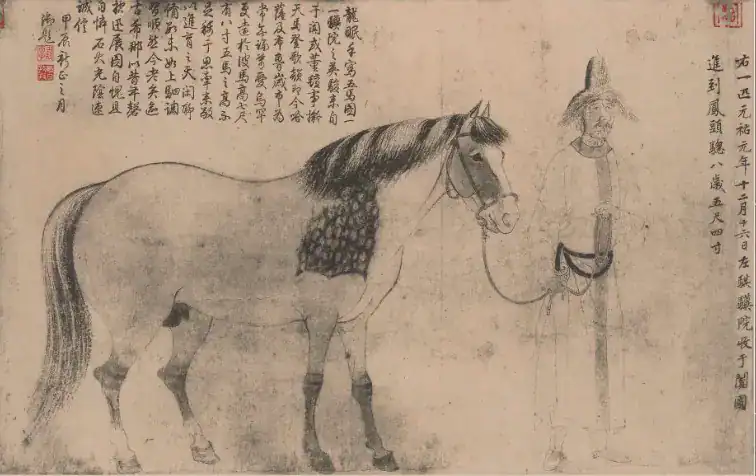
5. Five Tribute Horses (Wuma Tu, 五馬圖)
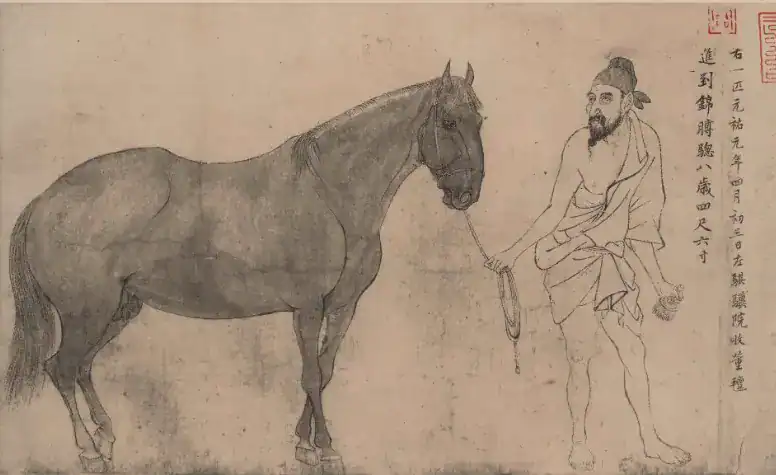
Five Tribute Horses, painted by Li Gonglin around 1090, portrays five actual horses gifted to the Song court alongside their grooms — a defining work of the Northern Song scholar-painter tradition. Painted in bai miao, Li Gonglin’s signature fine ink-line technique with minimal shading, the handscroll pairs each horse-and-groom portrait with a description written by the poet and calligrapher Huang Tingjian.
Li Gonglin’s empathetic, understated portrait style became a standard reference point for later Chinese figure and animal painting. The work is catalogued today with the National Palace Museum, Taipei.
6. Emaciated Horse
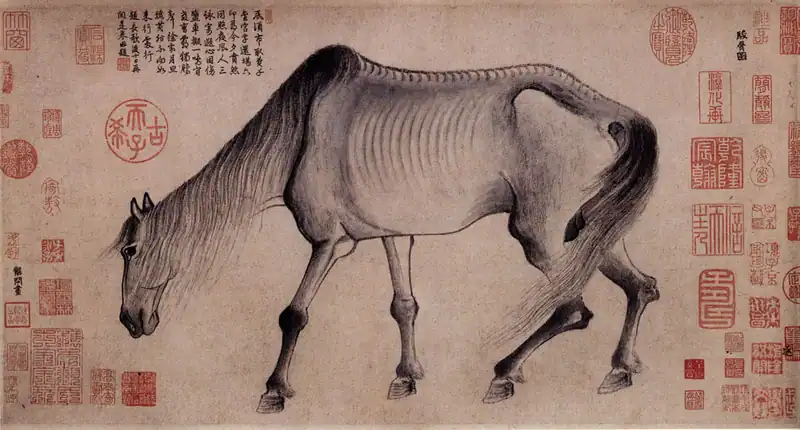
Emaciated Horse, by Gong Kai (active late 13th century), turns a single starving horse into one of Chinese painting’s most pointed political allegories. Painted in the turbulent transition from the Song to the Yuan dynasty, the gaunt animal was widely read as a stand-in for the loyal scholar-official left destitute rather than serve a new, illegitimate court. (Also catalogued under the title “Jun Gu, a Noble Horse.”)
The handscroll is held today by the Osaka Municipal Museum of Art.
7. Horse and Groom in the Wind
Horse and Groom in the Wind, by Zhao Mengfu (1254–1322), shows the Yuan dynasty’s most celebrated painter-calligrapher applying his famously fluid line to a windswept horse and its attendant. Zhao Mengfu, a descendant of the Song imperial family who nonetheless served the Mongol Yuan court, used horse painting throughout his career partly as a coded meditation on service, loyalty and changed circumstances.
The album leaf is held in the collection of the National Palace Museum, Taiwan.
8. Fat and Lean Horses (Er Ma Tu, 二馬圖)
Fat and Lean Horses, by Ren Renfa (1254–1327), pairs a sleek, well-fed horse with a gaunt one in a single composition — and comes with the artist’s own inscription explaining the political point. Ren Renfa wrote that the fat horse represents the self-satisfied official who enriches himself in office, while the lean horse stands for the honest official who grows poor serving the people.
Ren Renfa, who rose to Vice-President of the River Conservation Bureau under the Yuan, worked in the horse-painting tradition established by Li Gonglin. The painting is held by the Palace Museum, Beijing.
9. Two Horses
Two Horses, painted by Xu Beihong in 1947, is a quieter, more personal companion piece to his wartime galloping-horse works — painted, by his own inscription, “to dispel my sorrow.” Rendered in ink and color on paper, it shows Xu Beihong’s spirited, varying brushstrokes used to convey the animals’ naturalism and inner power rather than dramatic motion.
The painting is held today by the Spencer Museum of Art at the University of Kansas.
How to Draw a Chinese Horse Painting
If the masterworks above make you want to pick up a brush yourself, traditional Chinese horse painting follows the xieyi (“freehand” or “expressive”) style rather than tight outline-and-fill:
- Load the brush with graduated ink — darker at the tip, wetter and lighter toward the base — so a single stroke can suggest the roundness of a muscle without outlining it.
- Build the body first with broad, wet-on-wet washes for the torso and legs, working quickly before the ink dries.
- Switch to a drier brush for the mane, tail and hooves, where sharper, more textured strokes read as movement.
- Leave negative space (unpainted paper) to do as much work as the ink itself.
- Study the skeleton and muscle structure before simplifying it — Xu Beihong’s own technique came from combining Western anatomical drawing with traditional brushwork.
Contemporary Artists Continuing the Tradition
Beyond the historical masterworks, a number of living artists have built reputations specifically on horse painting. Their work isn’t (yet) in museum collections the way the pieces above are, but they’re worth knowing if you’re following the genre today.
Gao Teng
He has been in this field since 1995. An expert in drawing animals. The galloping horses she painted were unrestrained and lifelike.
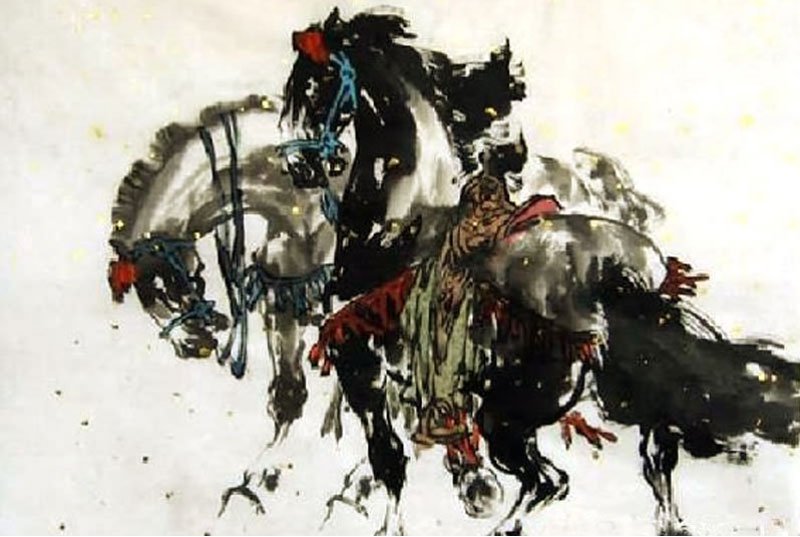
Chen Tian Xiang
A professional painter who is certified from the Fine Arts Department of Guangxi. Quite a talented painter specialized in beast painting and particularly horse painting. His work was welcomed by sino-foreign collectors.
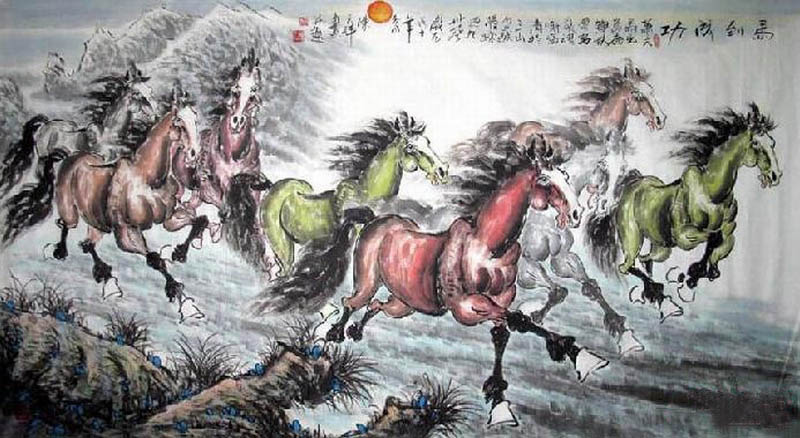
Jun Lin
Sichuan native, born in 1968. He is fond of drawing horses, dragons and so on. He is an advanced painter of Bashu Art academy and also a member of Chendu Calligraphy and painting association. His animal and particularly horse painting series are quite famous among the public in China and Asia.

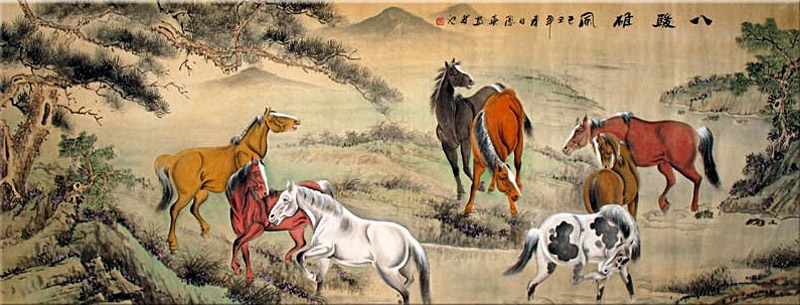
Qin Feng Ying
Qin Feng Ying comes from Mengshan county of Wuzhou. She graduated from the craft department of Guangxi Art institute. Her artwork is collected by different celebrities from within China.
Horses in Chinese Society
By studying the significance of horse art in China we get to know how deeply Chinese are in love with this. They feel proud of having a horse painting in their house as it is a symbol of power and strength.
Moreover, the sign of Chinese tourism is also designed based on a galloping horse a brown sculpture that depicts the strength and moving rhythms.

Besides this, horse symbols can also be seen in teaware, cup jars, etc.all over China which shows their love and dedication toward horse art.
Below you can watch two videos that shows how to paint horses in Chinese ink and wash technic.
Chinese Horse Painting: Frequently Asked Questions
Han Gan’s Night-Shining White (Tang dynasty, mid-8th century) is generally considered the single most famous Chinese horse painting, though Xu Beihong’s 1941 ink-wash Galloping Horse is the best-known work of the modern era.
The horse has long symbolized energy, ambition, loyalty and national spirit in Chinese culture, and was of direct practical and military importance to imperial courts – which made horse painting both an artistic and a political subject, especially from the Tang dynasty onward.
Most classical and modern Chinese horse paintings use ink-wash (shuimo) technique, often in the freehand xieyi style — graduated brush loading and negative space rather than tight outlines, though some Qing-era court works like Giuseppe Castiglione’s blend this with Western shading and perspective.
Xu Beihong (1895–1953) is widely credited as the pioneer of modern Chinese horse painting, having studied Western academic anatomy and perspective in Paris and fused it with traditional Chinese ink-wash brushwork.
Surviving works are spread across major collections including the National Palace Museum in Taipei, the Palace Museum in Beijing, the Penn Museum, and university museums such as the Spencer Museum of Art — see the individual entries above for specific locations.
psst… I hope you liked this short overview of Chinese Horse Painting and my personal choice of pictures. If yes give it some social love and pin, like or share. Much appreciated!