Quick Answer: Demos Chiang (b. 1976, Taipei) is a Taiwanese-Canadian designer turned painter whose anthropomorphic animal paintings blend Chinese ink tradition with Western abstraction. His solo exhibition All Things Have Spirit: Transformation of Matter · Sufficiency opened August 14, 2026, at the Xixi Tsai Chih-Chung Art Museum in Hangzhou, running through October 7, and includes two collaborative works made with cartoonist Tsai Chih-Chung and sculptor Ren Zhe.
An Unlikely Guest at the Wetlands Museum
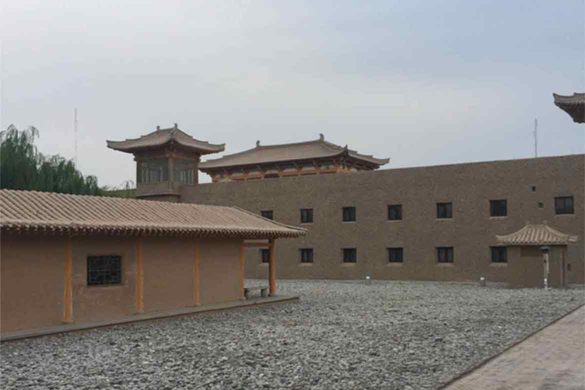
Walk through the Xixi wetlands on Hangzhou’s western edge and you eventually reach a museum built entirely around one man’s life work: the cartoonist Tsai Chih-Chung, whose comics on Chinese philosophy have filled its halls since 2024. This autumn, for the first time, the museum has handed part of its space to someone else. The guest is Demos Chiang, a Taipei-born designer who spent his twenties and thirties solving branding problems for the likes of Intel and Sony Taiwan, and who only started painting seriously in his forties. The animals he paints look like they have been waiting a long time to say something.
A Designer’s Detour Into Paint
Chiang was born in Taipei in 1976 and left for Canada as a child in 1988, the year his grandfather died and the family stepped back from public life. He later studied at New York University before returning to found the design studio DEM Inc in 2003, building a career around corporate identity work for major technology and consumer brands.
Painting was there from the start, just not as a vocation. As a boy, Chiang had informal access to several established guohua, or Chinese ink painting, masters, and has since described painting as the one childhood pastime he never actually enjoyed. It took decades, and a global pandemic, to change his mind.
Painting Through a Pandemic
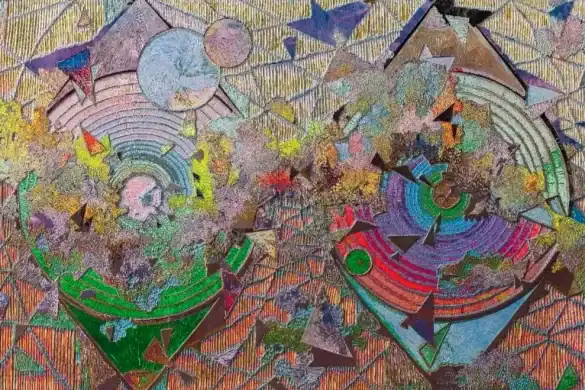
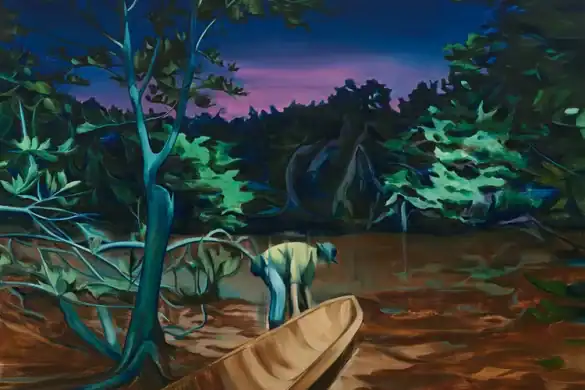
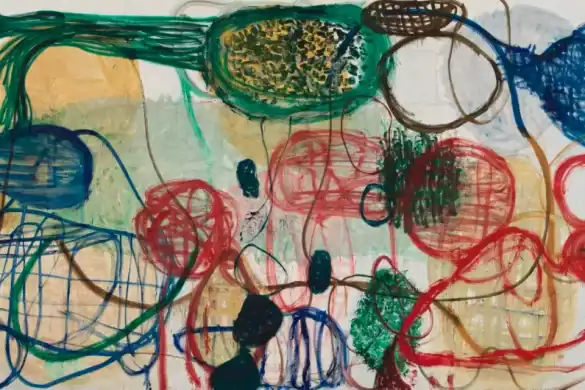
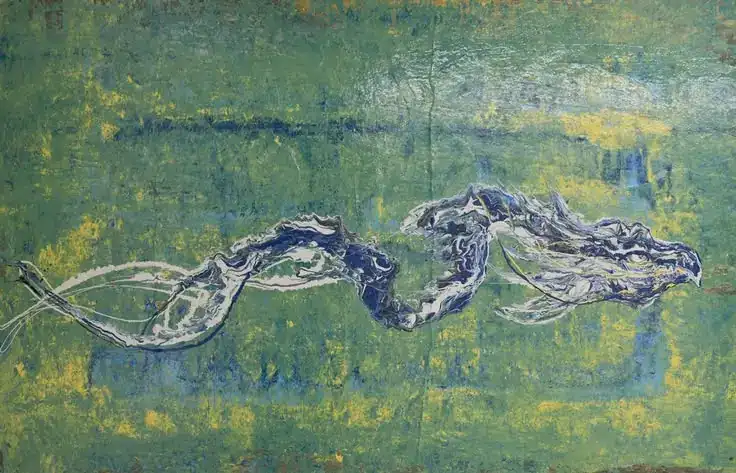
In 2020, with the world shut indoors, Chiang began reworking his relationship to the canvas. The paintings from his Reborn and Dream series that year use broad fields of colour to blur the outlines of his animal subjects, letting water and lacquer, which refuse to properly mix, build cloudy, forest-like textures on their own terms. The loose pours and drips borrow openly from American Abstract Expressionism, a technique Chiang folds into a distinctly un-Western subject.
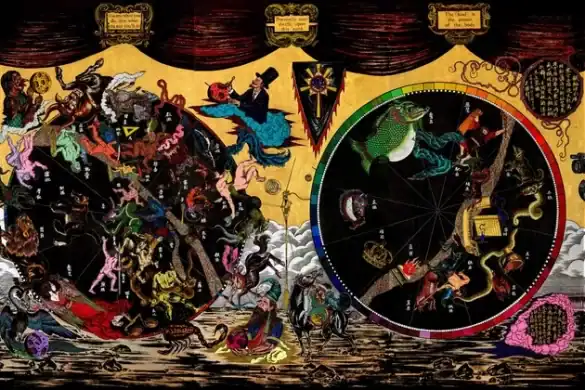
By 2021 that inquiry had become the Light series, in which torn passages of gold paint cut across otherwise composed pictures. Chiang has described the gold as standing for the fractures and losses of the pandemic years, and, at the same time, for a stubborn hopefulness about what comes after.
Discover more artists worth knowing
Get ChinaArtlover’s new artist portraits, exhibition notes, and stories behind the work in your inbox.
A Bestiary With a Pulse
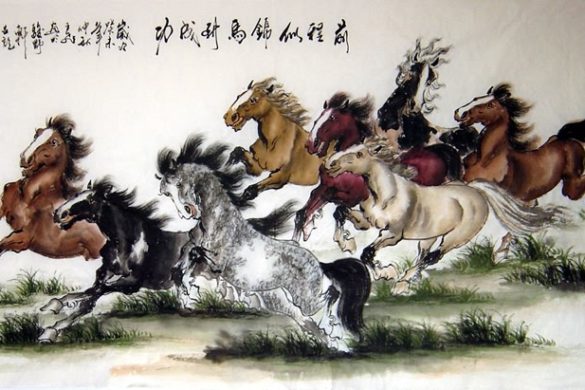
Chinese painting has its own long tradition of artists known chiefly for a single animal: our guide to Chinese Horse Painting traces how Xu Beihong made the horse practically his signature, alongside Zhang Daqian’s tigers, Qi Baishi’s shrimp, Li Keran’s water buffalo and Li Kuchan’s eagles, each prized less for anatomical accuracy than for catching an animal’s underlying spirit, or qi.
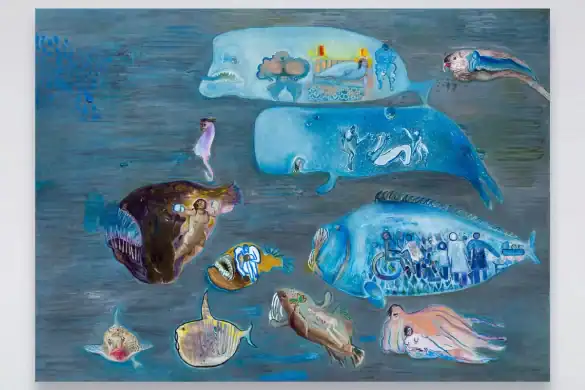
Chiang’s own lions, bears, tigers and leopards work against the fiercer end of that tradition. Even his most predatory subjects come across as tender, mournful or quietly amused, less a display of power than a mirror turned back on the artist’s own emotional state. Each canvas also carries a short, handwritten verse in English, a personal continuation, in an unexpected language, of the old literati habit of pairing image with inscribed poetry.
The technique underneath is Chiang’s own: he lets oil and water separate on the canvas rather than blending them, pours pigment directly, and drags a palette knife through the wet surface to open up layered, unpredictable textures. Readers curious about the brush-and-ink lineage this sits against might start with our explainer on Chinese Ink Wash Painting.
All Things Have Spirit at Xixi Tsai Chih-Chung Art Museum
All Things Have Spirit opened on August 14, 2026, and is organised into two units, Transformation of Matter and Sufficiency, together presenting 35 works: 31 paintings and 4 sculptures. Curator Wu Kezhi has structured the show around the Expressive Therapies Continuum, a framework borrowed from art therapy, to trace an emotional arc across Chiang’s recent output. In the curator’s own framing, Chiang’s restrained colour palette carries delicate emotion, with each canvas functioning as a kind of emotional slice, and the show as a whole balancing Eastern negative space against Western abstraction.
Two works step outside Chiang’s solo practice entirely. One painting was made jointly with Tsai Chih-Chung, the cartoonist whose museum is hosting the show; another piece was developed with sculptor Ren Zhe. At the opening, Tsai spoke about how creators of very different ages and backgrounds can still meet through shared ideas, calling the collaboration a rare kind of encounter.
All Things Have Spirit runs at Xixi Tsai Chih-Chung Art Museum, Gaozhuang, Xixi National Wetland Park, Xihu District, Hangzhou, through October 7, 2026.
Where Demos Chiang Stands Now
Chiang is represented by Whitestone Gallery, which presented his first solo exhibition in Taiwan. His current body of work marks a clear pivot: two decades spent solving other people’s branding problems have given way to a slower, more private practice built on inherited technique, borrowed Western gesture, and a menagerie that keeps circling the same handful of feelings. The restraint of a design career shows up in the paintings themselves, in how little is left on the canvas that doesn’t need to be there.
All Things Have Spirit runs at Xixi Tsai Chih-Chung Art Museum through October 7, 2026. For a closer look at individual works, follow us on Instagram, where this week’s spotlight walks through the exhibition piece by piece.
Demos Chiang: Frequently Asked Questions
Demos Chiang is a Taipei-born, Canada-raised designer and painter, known first for founding the design studio DEM Inc in 2003 and, since around 2020, for a body of paintings and sculptures centred on anthropomorphic animals.
As a child, Chiang had informal access to established guohua (Chinese ink painting) masters. His current paintings continue two literati-tradition habits, animal-as-subject and inscribed poetry, while using Western techniques such as poured pigment and palette-knife work.
The Chinese title, 万物有灵 (wanwu youling), is a traditional phrase meaning roughly that all things possess a spirit or soul. The exhibition’s two units, Transformation of Matter and Sufficiency, unpack that idea across painting and sculpture.
The show runs at the Xixi Tsai Chih-Chung Art Museum in Hangzhou through October 7, 2026.
He lets oil and water separate directly on the canvas, pours pigment rather than applying it purely by brush, and drags a palette knife through wet paint to build layered texture and depth.
Yes, Whitestone Gallery, which has presented his work including his first solo exhibition in Taiwan.
Further Reading & Sources
- Demos Chiang — Wikipedia (English)
- Demos Chiang — artist page, Whitestone Gallery
- 蒋友柏2026年度杭州个展亮相杭州西溪蔡志忠美术馆 — Hangzhou.com.cn (Chinese-language exhibition coverage)