Artist Portrait
Zhang Xiaogang: The Bloodline Paintings and Fifty Years Beyond Them
In a nutshell: Zhang Xiaogang (b. 1958, Kunming) is a Chinese painter best known for the Bloodline series, pale, photograph-like family portraits linked by thin red lines that made him one of the most internationally recognized Chinese artists of the 1990s and 2000s. A 2025 retrospective at Song Art Museum in Beijing, nearly 400 works and archival items spanning 1975 to 2025, reframes that famous decade as one chapter inside a much longer investigation of memory, objects, and light.
A row of faces looks out from an old family photograph: same grey suit, same studio backdrop, same carefully neutral expression. Zhang Xiaogang did not invent that kind of picture. Chinese studio portraiture from the mid-twentieth century had already perfected it. What he did was notice that the photograph was lying, quietly and completely, in the way all family photographs do, and spend the next three decades painting that lie.
The paintings that came out of that discovery, the Bloodline or Big Family series, made him one of the defining names of Chinese contemporary art’s arrival on the international stage in the 1990s. A major 2025 retrospective in Beijing makes the case that they were never the whole story.
Curious which Chinese artists galleries like White Cube pick up next? We follow the shows and the artists behind them, 1–2x a month.
Who Is Zhang Xiaogang?
Zhang Xiaogang was born in 1958 in Kunming, in China’s southwestern Yunnan province. In 1977, as higher education and art training were reopening after the Cultural Revolution, he entered the Sichuan Fine Arts Institute in Chongqing, graduating in 1982. His academy years exposed him to reproductions of European modernism at a moment when official Chinese painting still favoured Revolutionary Realism, and Vincent van Gogh in particular became a formative reference; an early painting, Coming Storm (1981), shows the debt to Van Gogh’s expressive, tactile brushwork directly.
The years immediately after graduation were difficult. Zhang worked outside the academic system he had hoped to join, and a 1984 hospitalization for an intestinal haemorrhage became the context for Ghost Between Black and White, a body of drawings and paintings turning private illness into symbolic images of mortality and isolation. It is an early, unpolished example of a habit he never really lost: converting a specific personal experience into a visual language other people could recognize as their own.
By the mid-1980s he was part of the broader experimental wave of Chinese art known as the ’85 New Wave, and a co-founder, alongside artists including Mao Xuhui, Pan Dehai and Ye Yongqing, of the Southwest Art Group. His Lost Dreams paintings of 1986 to 1988 worked through surreal, symbolic imagery, and 1988’s Eternal Love, joining two organic figures, shows an early debt to Frida Kahlo, an influence that would resurface directly in his most famous device a few years later. In 1989 he took part in China/Avant-Garde at the National Art Museum of China in Beijing, one of the defining exhibitions of the decade’s experimental art scene.
A 1992 trip to Europe, travelling at the invitation of the University of Kassel and visiting Germany, the Netherlands and France around the period of documenta, became the pivot toward what followed. Zhang encountered the work of Gerhard Richter directly, along with René Magritte and Giorgio de Chirico, artists concerned respectively with the mediated, historically loaded photograph and with estrangement inside ordinary imagery. He did not come back painting like any of them. He came back looking, for the first time with real intent, at the photographs already sitting inside his own family’s history.
The Bloodline Paintings: Turning a Family Photograph Into a Language
According to an interview Zhang gave M+, the idea for what became Bloodline took shape in the second half of 1993, after he came across old photographs from his own family; the birth of his first child in 1994 sharpened his thinking about what “family” actually meant. Museums generally treat 1994 as the point the mature series becomes recognizable, even though the germinating idea and some preparatory work date from the year before.
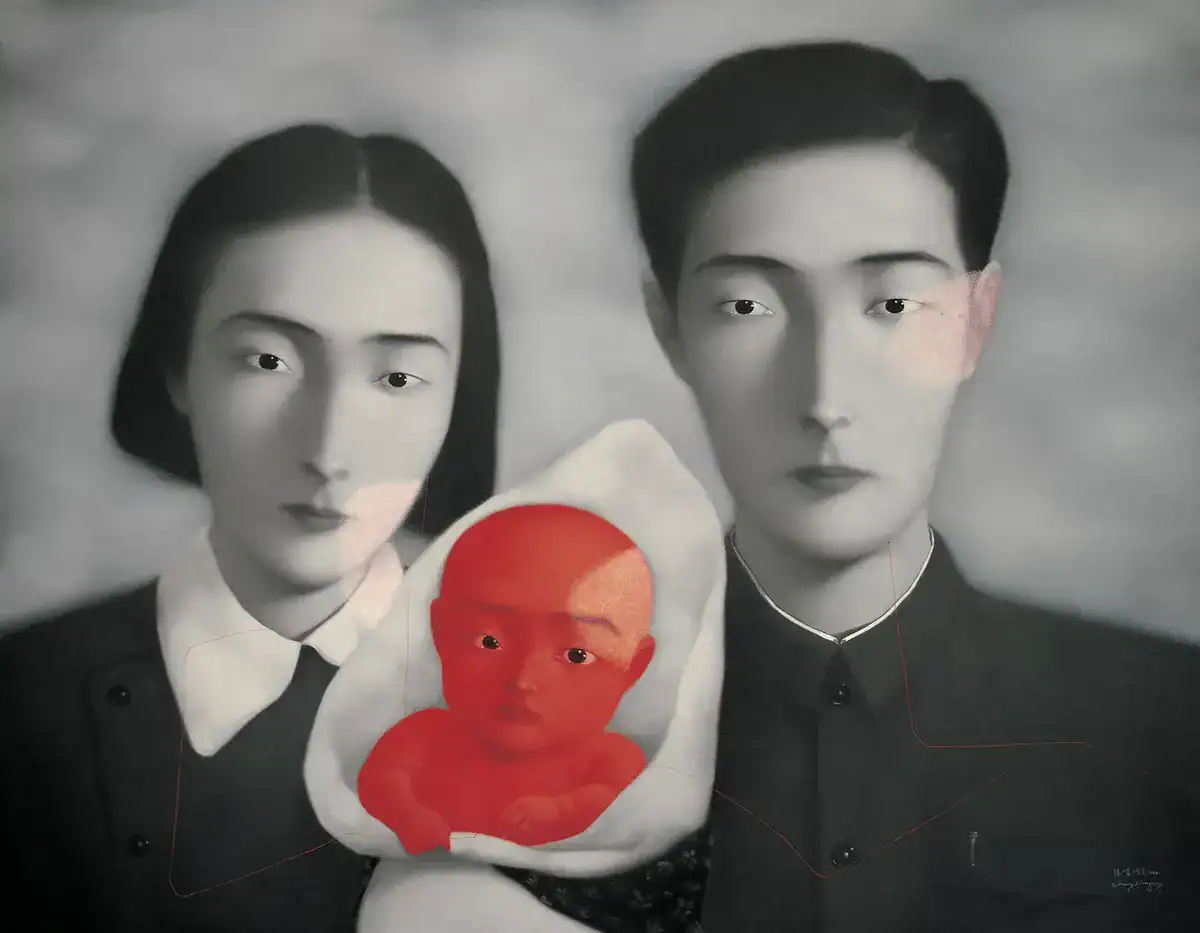
What Zhang found useful in mid-century Chinese studio photography was not likeness but a whole visual system: frontal poses, carefully controlled expressions, formal period clothing, retouched surfaces, and the quiet social pressure to present an acceptable version of a family. His paintings reproduce that system with faces rendered smooth and pale or grey, features that make relatives look alike while also flattening individuality, and small, deliberately artificial patches of light or colour breaking the photographic calm. Thin red lines connect the figures across the canvas.
Gerhard Richter’s example matters here less as a style to copy than as a demonstration: that a found family photograph could become a painting about memory itself; rather than a neutral record. Zhang’s Bloodline paintings often look like photographs that have faded, been retouched, or been lit from somewhere that does not quite make sense, occupying an unstable space between document and invention. Read that way, the series is not simply a set of family portraits. It is a set of paintings about how unreliable, and how constructed, family memory actually is, whether the family in question is a household, a work unit, a neighbourhood, or the wider collective structures through which identity was shaped in that period of Chinese history.
Why Are There Red Lines in Zhang Xiaogang’s Paintings?
The thin red lines connecting figures across a Bloodline painting are often explained too simply, as literal bloodlines or blood vessels. Zhang’s own account, recorded by M+, points somewhere more layered: he has said the device was influenced by Frida Kahlo’s way of visualizing bodily and emotional connection, and that he wanted to link people into a broader network, not only a biological family but inherited memory, emotional attachment, and social belonging all at once.
The effect works precisely because it refuses to resolve into one meaning. The lines visibly connect the figures. The faces, at the same time, stay emotionally distant, controlled, almost unreadable. That gap between connection and distance is closer to how family memory actually behaves than a straightforward genealogical chart would be.
International recognition arrived quickly once the language was in place. Zhang showed at the 22nd São Paulo Biennial in 1994 and the 46th Venice Biennale in 1995, and by 1998 to 1999 his work was included in Inside Out: New Chinese Art, one of the first large museum surveys to introduce experimental and contemporary Chinese art to North American audiences, opening at MoMA PS1 before travelling to institutions including SFMOMA. Within a few years of developing Bloodline, Zhang had moved from a regional Chinese art scene onto some of the most visible international stages available to any painter.
Beyond Bloodline: Objects, Sculpture, Paper and Light
From around 2003, Zhang’s work started to widen out under the heading Amnesia and Memory. The controlled, psychologically suspended mood of Bloodline stayed, but the family group was no longer the only subject. Isolated heads, objects, interiors, and half-remembered rooms took over more of the picture, treating memory not as a stable archive but as something incomplete and always at risk of being lost. Recurring motifs from this period, light bulbs, beds, televisions, notebooks, green domestic walls, suggest that the family photograph had, in effect, opened outward into the room around it. A 2004 painting, Big Family: Subway, folds the family group into exactly that kind of half-recognizable interior, the familiar faces now adrift inside a modern, anonymous public space rather than a studio backdrop.
Around 2007 Zhang moved into sculpture. My Ideal (2008), now in the Fondation Louis Vuitton collection, pairs a painting with five bronze figures, childlike bodies dressed in adult or occupational uniforms, translating questions of social role and identity into three dimensions. Pace’s 2009 Beijing exhibition Records pushed further into installation, with imagery extended onto stainless steel alongside diary-like text, light bulbs and televisions.
By the 2018 exhibition Recent Works, collage and torn paper had become central. A Frieze review by Banyi Huang describes pasted magazine material and visibly fragmented surfaces, the physical tear standing in for an incomplete memory rather than simply illustrating one; Huang’s review is also a useful critical counterweight, arguing that for all the formal experimentation, Zhang’s imagery stays closely tied to the symbolic vocabulary of earlier decades. That tension, between real formal change and a persistent visual memory, runs through everything Zhang made after Bloodline.
Long Museum West Bund’s 2023 exhibition Mayflies, more than fifty works made over the preceding three years, extended this into paper that is torn, punctured, stained and collaged, memory represented as something physically damaged rather than preserved. The same year, Pace Hong Kong’s Lost gathered recent paintings in which light itself becomes the subject: by his own account, Zhang had spent roughly three decades refining how illumination could reveal an object while making the space around it less certain, a motif that reaches back to the artificial highlights already present in his 1990s portraits.
The Painting and the Price
Zhang’s art history and his market history are two different stories that get told together more often than they should. By the mid-2000s, as Chinese contemporary art prices rose fast internationally, he became one of the names Western media used to illustrate that boom, a framing that says more about the period’s fascination with spectacular price growth than it does about the paintings themselves.
The auction record most often repeated, HK$94.2 million for Bloodline: Big Family No. 3 at Sotheby’s in 2014, is now out of date. Christie’s Hong Kong set the current record on 2 December 2020, selling Bloodline: Big Family No. 2 (1995) for HK$98,035,000, roughly US$12.7 million.
Writing in The Art Newspaper in 2018, critic Barbara Pollack offered a more useful retrospective reading than the market headlines usually allow. She recalled initially wondering whether Bloodline strategically emphasised visibly “Chinese” imagery to appeal to Western curators, then, after visiting Zhang and learning about the family photographs behind the work, concluded the origins were more personal, rooted in an individual search for identity, even as the international art system’s appetite for legibly “Chinese” imagery amplified how far the series travelled. Both things, in other words, can be true of the same paintings at once.
2025 and Beyond: Reading Zhang Xiaogang Across Fifty Years
The clearest recent argument for reading Zhang beyond Bloodline came from Zhang himself, or at least from an exhibition built around his own archive. The Reader, the Writer, curated by Cui Cancan at Song Art Museum in Beijing, ran from 13 September to 4 December 2025 and was described by Pace as the largest solo exhibition of his career: nearly 400 paintings, works on paper, installations, sketches, letters and archival documents spanning 1975 to 2025. Placing five decades in one museum makes a specific argument, that the internationally famous decade of family portraits is a single chapter, not the whole book.
2026 has continued that reassessment rather than moving on from it. Asia Art Archive’s At 25: Artists’ Early Worlds, Part I, at its CCG Library in Hong Kong from 17 March to 27 June 2026, included early material from Zhang, among it a 1983 self-portrait and diary-related studies, part of a wider curatorial project looking at artists around the age of twenty-five, before their mature public identities had formed. Zhang is also included, running from 16 September to 19 December 2026, in Thucydides Fever Dream at the Hill Art Foundation in New York, more than three decades after his first biennial appearances, still circulating in international group exhibitions rather than resting on the reputation of one series.
Why Zhang Xiaogang Still Matters
The easy version of Zhang Xiaogang’s career stops at a single, powerful image: pale family portraits, red connecting lines, a Cultural Revolution backdrop, then record auction prices. Every part of that is true, and none of it is the whole picture. Bloodline made him globally recognizable because it turned a personal discovery, a box of old family photographs, into a language legible to audiences who had never seen those specific photographs and never would. Everything Zhang painted afterwards, the objects, the green walls, the bronze figures, the torn paper, the studies of light, keeps working the same underlying question in different material: not what happened, but how unreliably, and how vividly, we go on remembering it.
Zhang Xiaogang: Frequently Asked Questions
Zhang Xiaogang (b. 1958, Kunming) is a Chinese painter who studied at the Sichuan Fine Arts Institute in Chongqing and became internationally known in the 1990s for his Bloodline family portraits. He lives and works in Beijing.
Bloodline, also known as Big Family, is a series begun in the 1990s of pale, photograph-like paintings of Chinese families, modelled on mid-century studio portraiture and connected by thin red lines. It grew out of Zhang’s discovery of his own family’s old photographs in 1993.
Zhang has said the red lines were influenced by Frida Kahlo and represent a network of connection that goes beyond literal bloodlines, linking biological kinship, inherited memory, emotional ties and social belonging in one device.
His verified auction record is HK$98,035,000 (about US$12.7 million), set at Christie’s Hong Kong on 2 December 2020 for Bloodline: Big Family No. 2 (1995). An earlier, frequently repeated figure of HK$94.2 million from a 2014 sale is now out of date.
From the early 2000s he moved into Amnesia and Memory, paintings of objects and interiors, then into bronze sculpture, steel and installation with Records, collage and torn paper in Recent Works, and paintings centered on light and material fragility in Mayflies and Lost.
The Reader, the Writer was Zhang Xiaogang’s largest solo exhibition to date, curated by Cui Cancan at Song Art Museum in Beijing from 13 September to 4 December 2025, bringing together nearly 400 works and archival items spanning 1975 to 2025.